
The sound of metal grinding against a rotor triggers instant panic in a driver. For you, the shop owner, that noise is the sound of the phone ringing,but only if your business is positioned to catch the call. Too many independent shops lean entirely on word-of-mouth or the occasional Facebook post, effectively leaving thousands of dollars in brake repair revenue on the table every single month.
The truth is, you don’t need a massive corporate budget to capture these leads. You just need a strategy that understands the immediate, fear-based nature of brake failure. When a driver feels a soft pedal or a shaking steering wheel, they aren’t ‘browsing.’ They are hunting for a solution, and they need it right now.
Key Notes
- Launch Call-Only Google Ads to skip the landing pages and connect stressed drivers directly to your service desk.
- Optimize your Google Business Profile by adding ‘Brake Shop’ as a secondary category to take over local search results.
- Automate your review requests via SMS the moment payment is processed to capture social proof while the customer is happy.
- Use transparent video content to break down pricing variables and eliminate the distrust customers often feel.
- Target ‘near me’ searches with aggressive geo-fencing, sticking to a tight 3-5 mile radius.
- Leverage urgency in your ad copy, speaking directly to safety concerns rather than just routine maintenance.
- Implement email retention campaigns to transform that one-time emergency brake job into a lifetime customer.
How To Get Leads Fast
When a customer is dealing with a safety issue, speed is the only metric that counts. Marketing for brake repair is fundamentally different from selling tires or cosmetic upgrades because your customer is usually in distress. Your goal is to remove every single barrier standing between their problem and your solution. Call-Only campaigns on Google Ads are the sharpest tool for this specific intent.
These ads show up on mobile devices and let the user dial your shop with a single tap, bypassing your website entirely. If a customer is stranded on the side of the road or too nervous to drive home, they aren’t going to read a long ‘About Us’ page.
However, you have to structure your Google Ads account with surgical precision to stop burning cash. You need to create a dedicated ad group strictly for brake services. Do not mix this in with general auto repair or oil changes. This separation lets you write a copy that speaks directly to that grinding noise or safety fear. Use geo-fencing to lock your ad delivery to a tight 3-5 mile radius around your shop. Brake customers rarely want to drive far in a car they feel is dangerous. Restricting your area ensures you own your local market rather than spreading your budget thin across the whole county.
Preserving your budget also means being aggressive with negative keywords. You want paying customers, not hobbyists. You need to exclude terms like ‘how to change brakes yourself,’ ‘cheap brake pads ebay,’ and ‘DIY brake repair.’ This ensures every dollar of ad spend targets drivers looking for a professional mechanic. You also need to balance your keyword match types. Broad match can waste money on searches that don’t apply, while exact match zeros in on users who have their credit card ready.
Optimizing Keywords and Match Types
Implementing a smart mix of match types helps you find the sweet spot between reach and relevance.
- Exact Match- Lean on keywords like ‘brake replacement cost’ and ‘fix grinding brakes’ to capture high-intent users who know precisely what they need.
- Broad Match Modifier- Use terms like ‘+brake +shop +[City Name]’ to catch necessary variations while ensuring the local intent stays front and center.
- Offer-Based Keywords- Terms like ‘brake inspection coupon’ attract price-conscious customers who just need a tiny nudge to choose you over the big franchise down the street.
- Financial Benchmarks- According to data from WordStream, the average Cost Per Click (CPC) for the automotive repair industry hovers around $2.46.
- Expected Volume- WordStream data also suggests an average conversion rate of about 6%, meaning you need a consistent budget to see real results.
- Digital Reliance- Think with Google reports that 95% of vehicle buyers use digital sources to get information, proving that relying solely on offline marketing is a dead end.
Dominate the Map Pack With Google Business Profile Optimization
The Map Pack,those top three results on Google Maps during a local search,is prime real estate. This little box drives the overwhelming majority of phone calls for local repair shops. If you aren’t in that top three, you are essentially invisible to a huge chunk of your market. Your primary category is likely set to ‘Auto Repair Shop,’ but you absolutely must add ‘Brake Shop’ as a secondary category. This signals to Google’s algorithm that you are the most relevant result for specific brake-related queries.
Engagement on your profile also signals activity and relevance to Google. Don’t leave the Q&A section gathering dust. Pre-populate this section yourself by asking and answering the questions you hear at the counter every day. Address concerns about turnaround time, warranty coverage on parts, and how you structure your pricing.
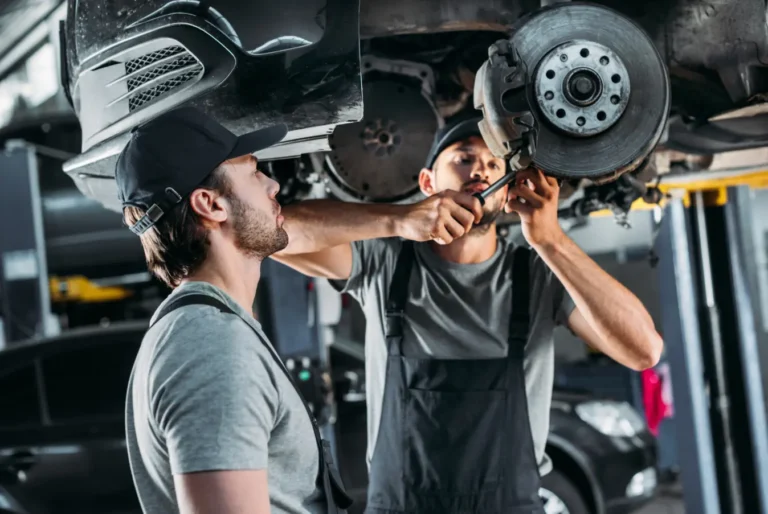
This gives prospects immediate value and improves the depth of your profile. Visual content is just as critical. A profile filled with generic stock photos fails to build trust. Upload real photos of your mechanics turning wrenches on calipers, machining rotors, or opening fresh boxes of brake pads.
Google Business Profile Action Plan
Taking a systematic approach to your profile prevents it from becoming stagnant. Double-check that your location is verified and your hours are 100% accurate, especially if you offer weekend drop-offs. Go into your dashboard and confirm that ‘Brake Shop’ is selected as a secondary category. BrightLocal research shows that businesses with more than 100 images on their profile get 520% more calls than average.
Turn on the messaging feature so customers can request quotes instantly without having to make a phone call. Naturally weave phrases like ‘local brake service’ and ‘brake mechanics [City Name]’ into your business description.
Build Unshakeable Trust Through Reputation Management
Let’s face it: the auto repair industry suffers from a historic trust deficit. Customers are often terrified of being overcharged or sold parts they don’t need. High review counts and detailed, professional responses are the only way to fight this skepticism. Waiting around for a customer to decide to leave a review is a losing strategy. You have to automate the process. Connect your point-of-sale system to a reputation management tool that shoots out an SMS request the second the invoice is paid. The customer is relieved their car is fixed, you need to catch them in that specific moment of satisfaction.
Negative reviews are going to happen, but they are actually an opportunity to show your professionalism. Never, ever argue with a customer online. Respond quickly, acknowledge their frustration, and offer to take the conversation offline. This response isn’t really for the person who complained, it’s for the hundreds of prospects who will read it. They want to see that you are reasonable and stand behind your work. According to Podium, 3.3 stars is the floor for what most consumers will consider, so protecting your average is vital for survival.
Scripting for Service Advisors
Your service advisors play a massive role in gathering reviews before the customer even walks out the door. Train your advisors to say, ‘If you’re happy with the safety check we did on your brakes today, look out for a text link to review us.’ This verbal prime drastically increases the odds that the customer will click the link when it pops up on their phone.
Use keywords like ‘trustworthy mechanic’ and ‘honest brake shop’ in your responses to reinforce your brand positioning. Podium data indicates that 93% of consumers say online reviews influence their purchase decisions. A calm, cool response to a bad review proves you are a professional business owner, not a defensive amateur.
Answer the Price Question With Transparency and Video Content
Price is always the biggest objection in brake repair. Customers simply don’t understand why one shop charges $200 and another charges $500. Content is your tool to bridge this gap. Create blog posts and videos that explain exactly what factors affect the cost. Discuss the difference between ceramic and semi-metallic pads. Explain why you might recommend replacing a rotor rather than resurfacing it. You don’t need to give an exact quote online, but explaining the variables establishes you as an authority rather than a commodity.
Visual diagnostics stop arguments before they even start. Use short videos to show the customer what a worn brake pad looks like compared to a new one. Embed these videos in your blog posts and send them directly to customers during inspections. When a customer sees the lip on a rotor or the metal-on-metal wear with their own eyes, the bill becomes a necessity rather than an upsell. Focus your content on symptoms. Customers search for ‘squeaking noise’ or ‘shaking steering wheel,’ not ‘warped rotor diagnosis.’ You have to meet them at their level of understanding.
Content Strategy for Authority
Educational content improves your search rankings and builds immediate trust. Write articles that address specific sounds and sensations, such as ‘Why do my brakes squeak?’ or ‘Shaking when braking.’ According to Think with Google, 56% of auto parts and service shoppers watch videos when researching, so show the repair process.
Embedding YouTube videos of inspections keeps users on your site longer, which signals quality to Google.Create a calendar featuring seasonal topics like ‘Winter Brake Safety’ or ‘Back-to-School Car Check.’ Address keywords like ‘average cost of brake job’ and ‘ceramic vs metallic brake pads’ to capture traffic that is in the research phase.
Leverage Urgency in the Brake Repair Customer Journey
Urgency is what drives the brake business. Unlike a cosmetic upgrade or a scheduled 60,000-mile service, brake work is often a grudge purchase triggered by fear. A driver hears a noise or feels the car pull to one side, and their safety instinct kicks in. Your marketing needs to validate and address this fear without being manipulative. Acknowledge that brake issues imply danger. Position your shop as the immediate solution to that danger.
Mobile behavior dominates this sector. The majority of searches happen on a smartphone, often while the customer is sitting in the car listening to the noise. Your conversion window is incredibly short, frequently less than 24 hours. Marketing for preventative maintenance is a slow burn, marketing for brake failure is a sprint. Transparency is non-negotiable, particularly for female customers who make up a significant portion of decision-makers but often feel vulnerable to upselling in repair shops. Clear explanations and visual proof respect their intelligence and earn their business.
Capturing Local Intent
Customers dealing with a safety issue simply will not drive across town. Leverage the massive increase in ‘near me’ searches by optimizing your site for your specific neighborhood and surrounding landmarks. Highlight attributes like ‘brake shop open now’ or ‘shuttle service available’ to remove logistical friction.
Invoca reports that over 25% of all automotive searches are related to parts, services, and services, indicating high daily demand. Use phrases like ‘squeaking brakes cost’ and ‘brake fluid flush cost’ to attract users ready to spend money. Drivers rarely travel more than 5-10 miles for basic maintenance, so keep your ad targeting tight.
Turn One-Time Fixes Into Lifetime Value With Retention Marketing
Acquiring a new customer is expensive. Keeping one is cheap. Brakes wear out on a predictable schedule. If a customer visits for an oil change and your technician notes 50% brake life remaining, that data shouldn’t die on the inspection sheet. Input this into your shop management software to trigger an automated reminder in six months. This turns a one-time transaction into a recurring revenue stream.
Use loss leaders to get cars on the lift. A free visual brake inspection costs you ten minutes of labor but provides the opportunity to identify hundreds of dollars in necessary work. Win-back campaigns are also highly effective. Target customers who haven’t visited in nine months with a specific discount on safety items. HBR notes that acquiring a new customer costs 5 to 25 times more than retaining an existing one. Do not let your existing database go cold while you chase new leads.

Email Marketing for Retention
Email remains a powerful tool for maintaining top-of-mind awareness. Send a ‘Brake Safety Reminder’ with the subject line: ‘Is your car stopping safely?’ Base emails on mileage or time intervals, such as ‘It’s been 20,000 miles since your last check.’ Include coupons for ‘free brake inspection’ or ‘seasonal car maintenance’ to incentivize the visit.
Email marketing in the auto industry sees respectable open rates, making it a viable channel for safety reminders. Utilize platforms like Mailchimp or shop-specific software like Shop-Ware to automate these touchpoints.
Frequently Asked Questions
How much should I spend on Google Ads for brake repair leads?
The budget really depends on your shop’s capacity and local competition, but starting with a daily budget that accommodates at least 10 clicks is a solid baseline. With an average CPC of around $2.46 in the auto industry (WordStream), a $25-$50 daily budget can generate meaningful traffic.
Consistency is more valuable than a sporadic high spend, a steady budget allows Google’s algorithm to learn which clicks actually convert into calls.
What is the best way to get more Google reviews for my shop?
Automate the request via SMS immediately after the service is paid for. Research from Podium suggests that convenience increases response rates, manual verbal requests often fail because customers simply forget by the time they reach home. Higher review volume directly correlates with better local map rankings, driving more organic calls over time.
How do I target local customers specifically for brake service?
Utilize geo-fencing within your Google Ads and optimize your Google Business Profile with the secondary category ‘Brake Shop.’
Customers seeking brake repair rarely travel outside a 5-mile radius due to safety concerns. Targeting a tight radius increases ad relevance and reduces wasted spend on drivers who are too far away to convert.
Why are my brake repair ads getting clicks but no calls?
You are likely sending mobile traffic to a desktop-optimized landing page or failing to use ‘Call-Only’ campaigns. Google data shows that 95% of vehicle buyers use digital sources, often on mobile, if they cannot find a phone number instantly, they bounce.
Switching to Call-Only ads removes the friction of a landing page, connecting the prospect directly to your service advisor.
Is SEO or PPC better for getting brake jobs?
PPC (Pay-Per-Click) is superior for immediate, high-urgency brake jobs, while SEO builds long-term authority.
A customer with grinding brakes needs help now and will click the first result (PPC), whereas a customer researching maintenance intervals might read a blog (SEO). A balanced strategy uses PPC for immediate cash flow and SEO to reduce acquisition costs over time.
How often should I email my existing customers about brake safety?
Send safety-specific reminders every 6 months or based on mileage intervals recorded during previous visits.HBR data indicates it is significantly cheaper to retain a customer than acquire a new one, regular touchpoints prevent them from drifting to competitors.
These emails should be educational and helpful, positioning the shop as a partner in vehicle safety rather than just a repair facility.
What keywords have the highest intent for brake repair?
‘Brake repair near me,’ ‘brake replacement cost,’ and symptom-based terms like ‘grinding noise when braking.’
Invoca reports that over 25% of automotive searches relate to parts and service, these specific terms signal a user is ready to buy.
Focusing on problem-aware keywords ensures you pay for leads who need a mechanic, not just information.
How does video content help sell brake services?
Video provides transparency that verbal explanations cannot match, showing the customer exactly what is wrong with their vehicle.Think with Google notes that 56% of shoppers watch video content, seeing a worn pad creates trust and validates the repair cost.
This transparency reduces friction at the sales counter and increases the average repair order value.
Can I use Facebook Ads for brake repair leads?
Facebook Ads are effective for brand awareness and special offers (like coupons) but less effective for emergency repair leads than Google Ads.Google captures intent (someone searching for a fix), while Facebook interrupts scrolling, use Facebook for retention and general maintenance offers.
Retargeting site visitors on Facebook keeps your shop top-of-mind for when they eventually do need service.
What is the average conversion rate for auto repair leads?
The average conversion rate for the automotive repair industry is approximately 6% for search ads (WordStream).
This metric helps you calculate how many clicks you need to purchase to fill your service bays.
Optimizing landing pages and using Call-Only ads can push this conversion rate higher by reducing steps for the customer.
How do I handle negative reviews about brake pricing?
Respond professionally, acknowledging the concern, and explaining the value of quality parts and labor, then offer to discuss it offline.Podium research emphasizes that prospective customers look at how a business handles negativity, a calm response builds trust.
Avoid getting defensive, use the response to educate the public on why cheap brake jobs can be dangerous.
What are the most common ‘near me’ searches for auto repair?
‘Brake repair near me,’ ‘mechanic near me,’ and ‘auto shop open now’ are top volume drivers.The surge in ‘near me’ queries reflects the mobile-first nature of the consumer journey. Optimizing your Google Business Profile and website for these terms captures the high-intent traffic in your immediate vicinity.